
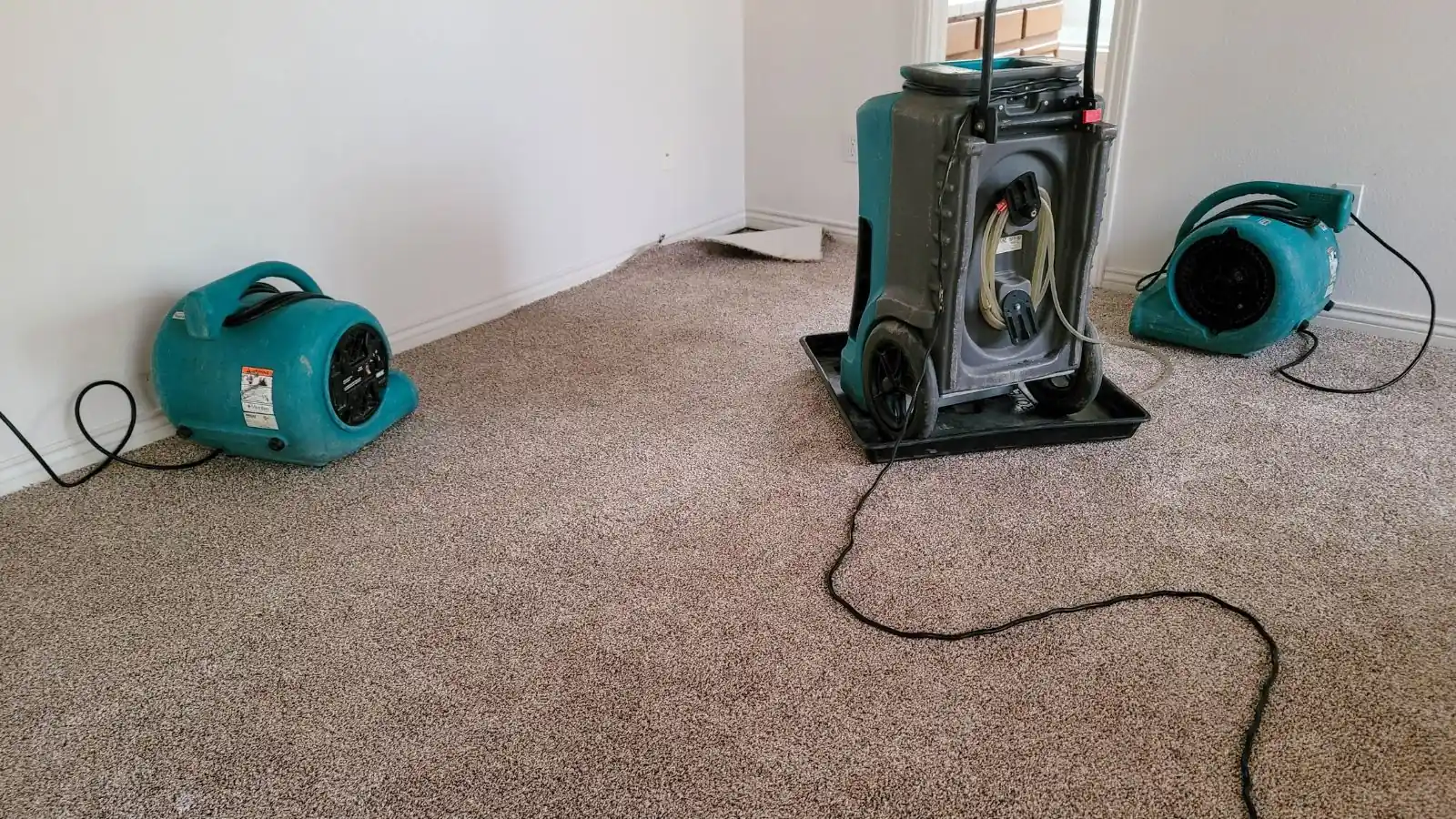
Structural drying is the controlled removal of moisture from the building itself: framing, subfloor, drywall, plaster and concrete. It starts after the standing water is gone. Dehumidification is the half of the job that takes the evaporated water out of the air so the materials can keep releasing it.
For Nanuet homeowners the usual reason to call is simple. The leak was fixed, the floor was mopped, and days later the room still smells damp or the baseboards have started to swell.
Wall still damp, floor still cold? That is what this service fixes
People rarely search for structural drying by name. They search for a wall that will not dry out, a damp smell after a leak, or how to dry out a house after water damage. The trade answer to all of those is this service. Our industry also calls the early stage water mitigation, meaning the work that stops damage from spreading before repairs begin.
Water mitigation and drying, explained
Water mitigation is everything done to limit the loss: stopping the source, extracting water, removing materials that cannot be saved and setting drying equipment. Structural drying is the part of mitigation that runs for days afterward. Restoration, the rebuilding, comes last.
The order matters to a homeowner because new drywall and flooring must not go onto wet framing. A common request from callers is for one quote that covers drying and the repairs. We scope both, and we explain which numbers are firm and which depend on what the readings show.
The equipment, in plain words
| Equipment | What it does | Where you will see it |
|---|---|---|
| Air mover | Pushes fast, low air across wet surfaces so water evaporates | Along walls and on floors, several per room |
| LGR dehumidifier | Pulls that water vapour out of the air and pumps it to a drain | One or more per affected area |
| Moisture meter | Reads moisture in wood, drywall and concrete | In the technician's hand at each visit |
| Thermal camera | Shows cool, damp areas behind surfaces | Used at the first inspection |
| Floor mats and cavity systems | Draw air through hardwood or into wall cavities | Where floors or walls are dried in place |
The machines are loud and warm, and they need to run day and night to work. Switching them off overnight is the most common reason a job runs long. They are part of the job and leave with the crew. We do not hire out air movers or dehumidifiers on their own.
Moisture mapping and the drying log
Moisture mapping means measuring and recording where the building is wet. At the first visit we take readings on affected materials and on matching dry materials elsewhere in the house, which gives a dry standard for your home. Every later visit repeats the readings in the same spots.
That record is the drying log. It shows the trend down to the dry standard and is the evidence that the structure was dry before it was closed up. It is also useful paperwork for an insurance file. The method follows the ANSI/IICRC S500 standard.
How a drying job runs
- 1
Inspect and map
Readings and thermal images define the wet area.
- 2
Scope and price explained
You hear how much equipment, roughly how many days and how pricing works before starting.
- 3
Prepare the materials
Baseboards come off, wet pad is pulled, and holes or flood cuts open closed cavities where needed.
- 4
Set equipment
Air movers and dehumidifiers are placed to a calculated plan, not by guesswork.
- 5
Monitor
Readings are taken and equipment adjusted on return visits.
- 6
Sign off
Equipment is removed when materials reach the dry standard.
Fixed the leak but the room still feels damp? Call and ask for a moisture assessment.
Call (833) 521-1033How long drying takes
Most clean-water losses dry in about three to five days of continuous running. Dense or layered materials take longer: plaster, hardwood, double layers of drywall, and concrete. Humid summer weather in Rockland County slows evaporation in a house without air conditioning, and a cold unheated room slows it in winter. We do not promise a day count on the phone, because the readings decide.
Nanuet's housing spans many decades of building, from older houses near the station to homes and garden apartments that followed the mid-1950s highways. Wall construction differs across those eras, so ask us to explain what your walls are made of before a drying plan is agreed. Plaster and drywall behave differently.
Cost factors
Scope and drying on this service follow the ANSI/IICRC S500 standard for water damage restoration.
Drying after a covered sudden loss is usually part of the same insurance claim. Coverage depends on the cause and your policy, so check it or ask your insurer.
Specific materials have their own pages: hardwood floors, carpet and pad and walls and drywall. We dry buildings in Nanuet and in Pearl River, West Nyack, Blauvelt, Nyack and Valley Cottage.
Safety guidance: do not touch wet outlets, switches or cords. Switch off the affected circuit only from a dry panel, and call the utility if you are unsure.
Structural drying questions
How do I dry out a wall after a leak?
A wall dries when air can reach the wet side and a dehumidifier removes the moisture. That often means taking off the baseboard and opening small holes or a strip at the bottom. Fans alone in a closed room mostly move damp air around.
Can I rent the equipment from you?
No. Equipment is used on jobs we monitor and is not hired out. The value is in the measuring: knowing where it is wet, when it is dry and when to stop.
How will I know it is really dry?
You will see the readings. The drying log compares wet areas to dry reference materials in your own home, and equipment comes out only when they match.
Do the machines have to run all night?
Yes. Drying is continuous. Turning equipment off for part of the day lets materials reabsorb moisture and adds days to the job.